
As wildfires, urban fires, and industrial emergencies continue to challenge emergency response teams, firefighting drones are becoming valuable tools for aerial monitoring, thermal imaging, fireground assessment, and search and rescue support. For fire departments, industrial safety teams, emergency management agencies, and commercial UAV distributors, these systems offer new ways to gather critical information while reducing personnel exposure to hazardous environments.
However, a reliable firefighting drone program requires more than an aircraft. Thermal cameras, propulsion systems, batteries, electronic speed controllers (ESCs), communication equipment, and replacement components all contribute to operational readiness.
For B2B buyers, understanding global firefighting drone applications and long-term maintenance requirements is essential when selecting equipment and building a dependable supply chain.
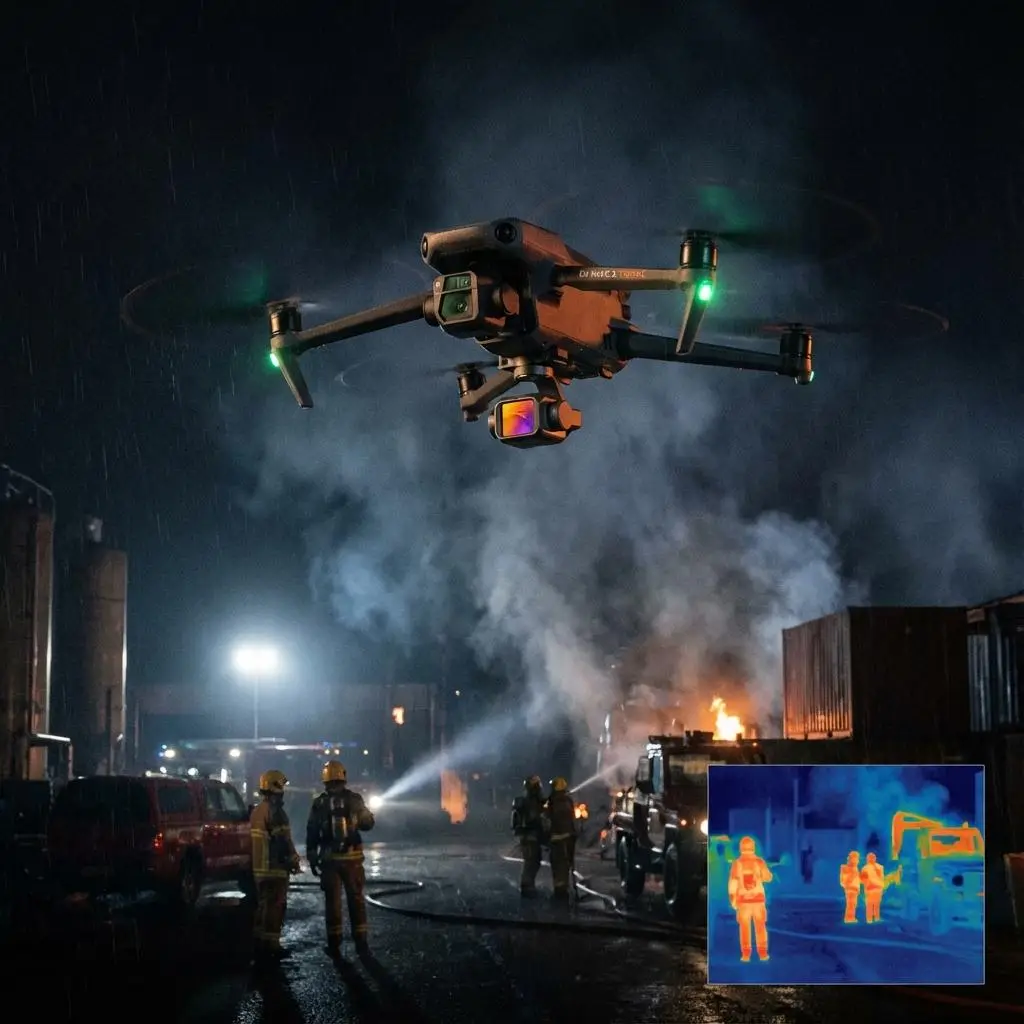
1. How Firefighting Drones Are Used Around the World
Firefighting drones serve different purposes depending on local fire risks, terrain, infrastructure, regulations, and emergency response capabilities. In many operations, their primary role is to improve situational awareness rather than replace traditional firefighting aircraft or ground crews.
Wildfire Monitoring and Forest Fire Detection
Wildfires can spread across large areas of forest, grassland, and remote terrain. Ground teams may struggle to identify hotspots, assess fire boundaries, and monitor changing conditions from a safe position.
Equipped with thermal imaging cameras and high-resolution visual sensors, firefighting drones can help operators identify heat signatures, monitor fire perimeters, assess affected areas, and provide aerial information to incident commanders.
In the United States, the Federal Aviation Administration (FAA) works with wildfire response partners to support the safe integration of unmanned aircraft into wildfire operations. These operations emphasize airspace coordination and the protection of crewed firefighting aircraft.
For more information, visit the FAA’s UAS in Wildfire Response resource.
Urban Firefighting and High-Rise Buildings
In densely populated cities, fires involving high-rise buildings, commercial properties, and residential complexes can create difficult access conditions.
Firefighting drones equipped with thermal cameras can help emergency teams examine rooftops, locate potential hotspots, inspect building exteriors, and assess conditions around hard-to-reach areas.
Visual and thermal data can support decisions about where to deploy personnel and equipment. However, drone operations must be coordinated with other emergency aircraft and conducted in accordance with applicable aviation requirements.
Industrial Facilities and Hazardous Environments
Industrial sites such as warehouses, factories, chemical facilities, energy installations, and logistics centers may contain combustible materials, electrical equipment, or other hazards.
Industrial firefighting drones can support perimeter inspections, thermal monitoring, remote scene assessment, and post-incident inspections. Depending on the payload and certification of the system, specialized sensors may also assist with identifying abnormal heat or environmental conditions.
For facility managers, drones can form part of a broader emergency preparedness and industrial inspection program.
Search and Rescue During Fire Emergencies
Smoke, poor visibility, unstable structures, and difficult terrain can complicate rescue operations.
Drones equipped with thermal imaging, spotlights, loudspeakers, or specialized cameras can help responders survey affected areas and search for people who may be difficult to see from the ground.
The usefulness of these systems depends on sensor performance, weather conditions, communication reliability, operator training, and the specific emergency environment.
2. Regional Demand for Firefighting Drones
The operational priorities of firefighting drone buyers vary across regions. Suppliers should evaluate the mission requirements of their target customers instead of assuming that a single configuration suits every market.
North America: Wildfire Response and Public Safety
In the United States and Canada, wildfire monitoring, emergency management, infrastructure protection, and search and rescue are important application areas.
Potential buyers include fire departments, public safety agencies, emergency response contractors, utilities, and industrial operators.
Common procurement priorities include thermal imaging performance, reliable communication, flight endurance, rapid deployment, and integration with existing emergency response procedures.
In the United States, operators must also determine which FAA rules, authorizations, or waivers apply to their missions.
Europe: Urban Safety and Industrial Fire Prevention
European buyers may prioritize industrial facility inspections, urban fire assessment, infrastructure monitoring, forest fire prevention, and emergency response.
For distributors, useful product considerations include payload compatibility, serviceability, documentation, battery availability, and support for the customer’s intended operating environment.
Because aviation rules and operational requirements can differ by country and mission, suppliers should encourage customers to verify local requirements before purchasing equipment.
Australia: Bushfire Monitoring and Remote Operations
Australia’s extensive rural areas, forested regions, and remote infrastructure create potential applications for aerial fire monitoring and emergency assessment.
Drones can help operators survey large areas, identify heat anomalies, and collect information from locations that are difficult to reach on foot.
Longer flight endurance, dependable communications, weather tolerance, and efficient battery management may be important selection criteria for these missions.
Asia-Pacific: Industrial Safety and Emergency Preparedness
Across Asia-Pacific, potential applications include factory safety, warehouse monitoring, infrastructure inspection, urban emergency response, and wildfire assessment.
Industrial operators may also use thermal imaging drones to inspect electrical equipment, solar installations, and other assets as part of preventive maintenance programs.
For B2B suppliers, demand may extend beyond complete aircraft to include sensors, batteries, motors, wiring assemblies, and other replacement components.
These regional examples describe potential application areas rather than a ranking of current market demand. Actual opportunities depend on local budgets, procurement policies, operational requirements, and regulatory approval.
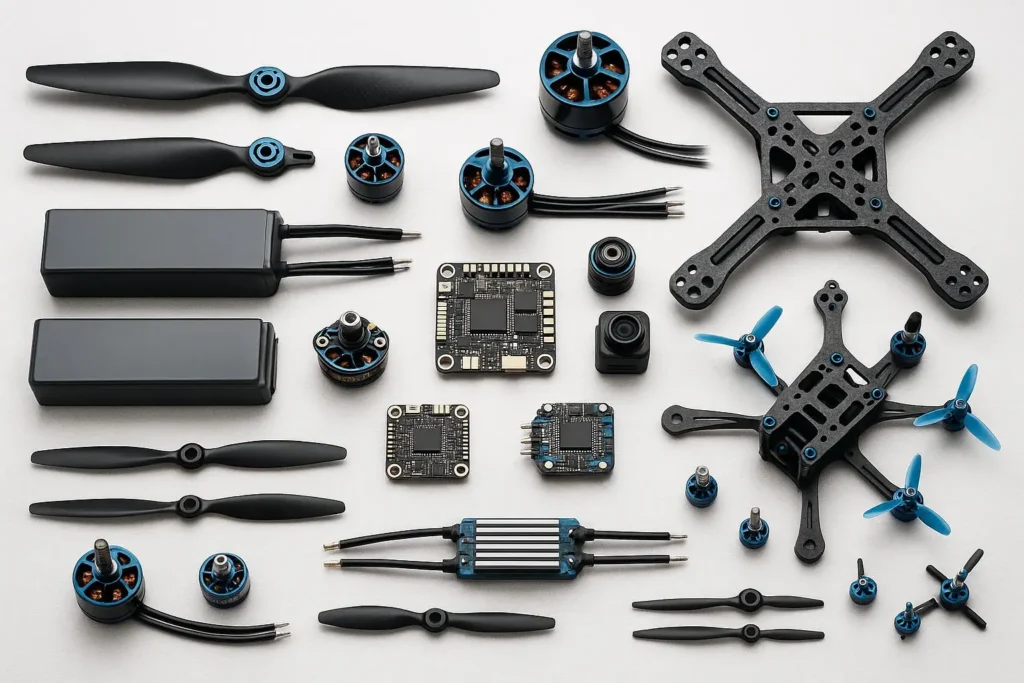
3. Essential Firefighting Drone Parts and Components
Selecting suitable firefighting drone parts is critical for maintaining performance and reducing avoidable downtime. Buyers should confirm compatibility with the exact aircraft model, payload configuration, and operating conditions before ordering replacement components.
Thermal Imaging Cameras and Sensor Modules
Thermal cameras help operators visualize temperature differences and identify potential hotspots that may not be visible through a standard camera.
Important considerations include thermal resolution, temperature measurement capabilities, image transmission, mounting compatibility, and environmental protection.
Thermal sensors should be selected according to the mission and the information required by the response team.
Motors, Propellers, and ESCs
Motors, propellers, and electronic speed controllers are essential parts of a multirotor drone’s propulsion system.
Vibration, dust, impacts, frequent transport, and demanding flight conditions can increase inspection and maintenance requirements.
B2B buyers should verify motor specifications, propeller dimensions, ESC ratings, connector compatibility, and manufacturer recommendations before replacing components.
Batteries and Charging Systems
Battery availability directly affects how quickly a drone team can prepare for another mission.
Fire departments and industrial operators should consider battery condition, cycle history, charging requirements, storage procedures, and manufacturer-approved replacement intervals.
For distributors, maintaining appropriate stock of compatible batteries and charging equipment can help customers manage planned maintenance and routine replacement needs.
Power Cables, Connectors, and Electronic Modules
Power cables, signal cables, connectors, flight-control components, and power distribution modules are also important parts of an industrial UAV maintenance strategy.
A damaged connector or incompatible cable may prevent a drone from operating correctly even when the main aircraft remains in good condition.
Suppliers should provide accurate part numbers, specifications, compatibility information, and installation guidance where available.
Payload Mounts and Structural Components
Landing gear, mounting brackets, airframe components, and payload attachment systems may require inspection after hard landings, transportation incidents, or demanding field operations.
Correct replacement parts help preserve the intended aircraft configuration. Any structural repair should follow the manufacturer’s procedures and applicable maintenance requirements.
4. Firefighting Drone Maintenance: How to Reduce Downtime
A dependable maintenance program is just as important as the initial equipment purchase.
Emergency response teams may need to deploy equipment with little notice, so maintenance planning should cover routine inspections, replacement inventory, and clear records of component condition.
A practical maintenance workflow includes:
- Pre-flight inspection: Check propellers, motors, airframe condition, batteries, cables, connectors, and payload attachment points.
- Post-flight inspection: Look for impact damage, abnormal vibration, overheating, loose fasteners, and signs of contamination.
- Battery management: Track battery condition and follow the manufacturer’s charging, storage, and replacement guidance.
- Sensor verification: Confirm that thermal and visual payloads are functioning correctly and that recorded information is usable.
- Scheduled servicing: Follow manufacturer instructions for inspections, firmware updates, component replacement, and maintenance records.
- Repair documentation: Record the fault, affected component, repair action, and any required verification before returning the aircraft to service.
After exposure to intense heat, smoke, water, chemicals, or impact, a drone may require additional inspection before its next mission. Never assume that an aircraft is safe to operate simply because it powers on.
5. Why Firefighting Drone Spare Parts Matter to B2B Suppliers
The commercial opportunity extends beyond selling complete drones. Fire departments, industrial customers, maintenance providers, and fleet operators also need access to compatible replacement components throughout the equipment lifecycle.
For a firefighting drone supplier, a well-planned aftermarket offering can include:
- Motors, propellers, and propulsion components
- Batteries and charging equipment
- ESCs and power distribution modules
- Cables, connectors, and electronic assemblies
- Thermal camera accessories and payload mounts
- Landing gear and structural replacement parts
- Approved maintenance accessories and service support
The best inventory strategy starts with customer fleet data, manufacturer maintenance schedules, component lead times, and historical replacement requirements.
Rather than stocking every component, distributors can prioritize critical parts that are difficult to source quickly or that regularly appear in customer maintenance requests.
Suppliers should also confirm that parts are genuine or appropriately specified, compatible with the customer’s aircraft, and supported by reliable technical documentation.
6. How to Choose a Reliable Firefighting Drone Supplier
Choosing a supplier involves more than comparing the purchase price of an aircraft or replacement component.
Product compatibility: Confirm the exact model, part number, connector type, payload interface, and electrical specifications.
Quality assurance: Ask about inspection procedures, traceability, product documentation, and applicable testing records.
Supply continuity: Review stock availability, production lead times, minimum order quantities, and repeat-order arrangements.
Technical support: Determine whether the supplier can assist with component identification, compatibility questions, and troubleshooting.
After-sales service: Understand the process for defective parts, warranty claims, replacement orders, and maintenance support.
Regulatory suitability: Check whether the proposed aircraft, payload, battery, and operating configuration meet the requirements of the intended market and mission.
For distributors serving multiple customer groups, a supplier with a broader industrial UAV product range may also simplify sourcing across firefighting, inspection, agriculture, and other commercial applications.
7. Why Consider HF Drone for Industrial UAV Sourcing?
HF Drone provides agricultural and industrial UAV solutions, with product categories covering different commercial applications and replacement components.
For B2B buyers, exploring a supplier’s product range can help identify suitable platforms and components for specific operational requirements.
You can explore HF Drone’s industrial drone applications and review the DJI parts catalog for available product categories.
If you are sourcing components for a firefighting or emergency response project, provide the aircraft model, required part numbers, operating environment, estimated order quantity, and destination market when making an inquiry. This information helps establish whether the requested products are suitable and available.
To discuss industrial UAV sourcing requirements, visit the HF Drone contact page.
8. The Future of Firefighting Drones: Readiness, Reliability, and Maintenance
Firefighting drones are increasingly relevant to aerial monitoring, thermal inspection, emergency assessment, and search and rescue support.
As organizations develop their drone programs, purchasing decisions will increasingly involve the complete equipment lifecycle: aircraft capability, payload performance, operator training, regulatory compliance, maintenance procedures, and replacement-parts availability.
For B2B distributors and industrial UAV suppliers, understanding these requirements creates opportunities to support customers beyond the initial sale.
The long-term value of a firefighting drone program depends not only on the aircraft itself, but also on the quality of its components, the reliability of its maintenance process, and the readiness of the people operating it.
Conclusion
From wildfire monitoring in remote landscapes to industrial fire assessment and urban emergency response, firefighting drones can provide valuable aerial information to emergency teams around the world.
Choosing the right platform is only the first step. Thermal imaging equipment, motors, propellers, batteries, ESCs, cables, and structural components all deserve careful attention throughout the equipment lifecycle.
For fire departments, industrial operators, and B2B distributors, a well-planned maintenance and replacement-parts strategy can improve equipment readiness and support more consistent operations.
Looking for industrial drone solutions or replacement components? Contact HF Drone to discuss your B2B sourcing requirements and explore available products for your application.